
Based Fantasy: The First Law
Practical Magic!


I’m not going to spend a lot of time bashing George R.R. Martin. That’s well-tread territory. It’s actually sad what happened to him. He was off to a great (albeit meandering) start, then he made the mistake of writing about the Iron Bank, which got a little too close to the truth about the realities of Global Banking, so the Rothschilds had him replaced with a fatter clone.
Here’s the real point: Joe Abercrombie’s First Law Trilogy is better than George R.R. Martin’s A Song of Ice and Fire in every way. The themes are similarly dark, but the plot is tighter with no dead ends or spotlights on boring characters. But gasp, it’s still fun. It’s not literature as medicine or as punishment. Unlike GRRM, who hated Tolkien, Abercrombie is writing a love letter to the fantastical and succeeds in subverting subversion itself.
I’ll begin with the end. The ending, that is. The story ends! What a concept. It also doesn’t overstay its welcome; this is true of the crisp prose in the pages and the number of books in the series. A compelling fantasy epic doesn’t have to meander into seven or a dozen books. Let me state my premises:
A triangle is the most stable structure in nature.
A trilogy is the most stable structure in literature.
The rule of three, when writing an argument, makes that argument virtually unassailable.
If you enjoy masterful strokes of wit like you just witnessed, you’ll love this book. Yes, the books are funny. This is due in large part to the fun cast, their great dialogue, and their biting inner monologues.
TFL is a fantasy in the “grimdark genre”, the themes of which are brutality, realpolitik, and civilizational chaos. Grimdark also relies on the subversion of fantasy character tropes. I know we’re all fatigued by the vandals in the creative arts, but rest assured this is not a gritty reboot where an already perfect neo-damsel girlboss nags the weak males into submission.
Let’s scan the Protagonists:
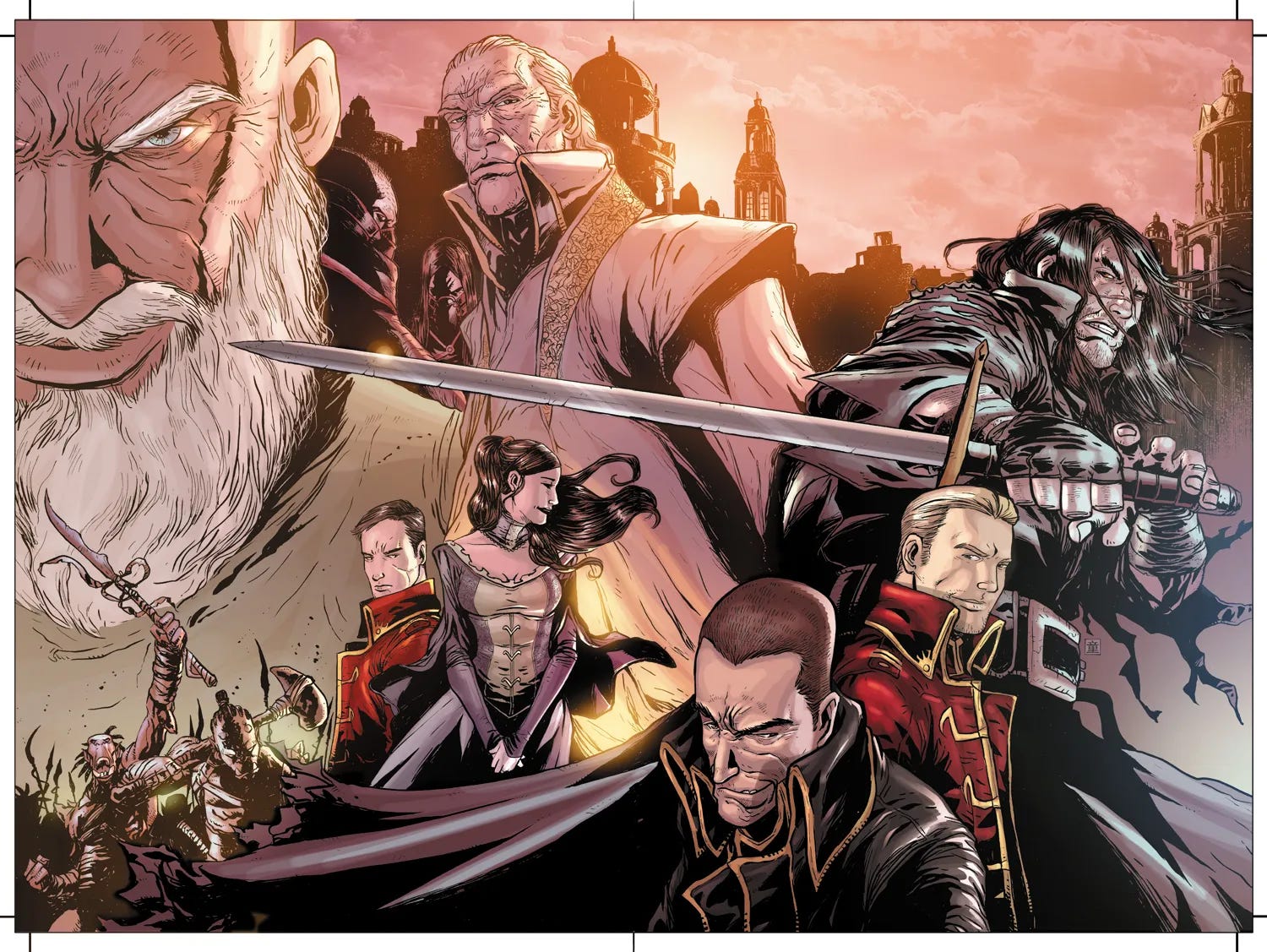
Logen Ninefingers: Murderous barbarian viking with a heart of gold. When the going gets tough, a demonic berserker spirit takes over his mind, but he’s getting too old for this shit. His arc is a tension between his desire for vengeance and washing the blood of the past from his hands.
Jezal dan Luthar: Latin for “Jizzy Lothario.” The arrogant young knight, smacked hard in the face by reality and humbled. His arc in the first book - training for the fencing championship - is up there with any great sports movie.
Sand dan Glokta: A former avatar of knightly virility, he led a heroic charge during the last war that saved the day. This act also resulted in his capture, torture, and crippling. Every other tooth has been pulled out of his mouth. His ruined left leg drags behind him. Now, because “hurt people hurt people”, he works for the Inquisition (basically the medieval CIA). The hilarious interactions between him and his boss read like an angry police captain dressing down the loose cannon detective. Abercrombie managed to make a sociopathic, scheming torturer the funniest and most sympathetic character in the series.
Colum West: the exasperated military officer in a sea of incompetence, handicapped by his low birth, violent temper, and migraines.
Ferro Maljinn: Abercrombie somehow gets away with naming a character “Feral-Iron Bad-Genie.” But when you’re good at what you do, might as well be on the nose. Ferro has coal black skin, gold eyes, and demon’s blood. A nasty freed slave on her own revenge quest, you’ll delight in referring to her white companions as, “Fucking Pinks!” She’s not a girl boss, but a flawed B.A. Baracus.
Ardee West: A delightful young maiden. Olive skinned, buxom, drunk, acerbic, and a worthy foil to Luthar. Reminds me of my cross-eyed college girlfriend.
Bayaz: First of the Magi, apprentice to Juvens, son of Euz. He’s a grand old wizard who lives in a library. Like Gandalf, he sets the course for adventure. Unlike Gandalf, he’s an absolute bastard: a power-hungry chessmaster treating most of the protagonists as his game pieces.
You: “Well, that’s all well and good, but how is this based?”
This, the most interesting part of the essay, will contain spoilers, so if you want to read the book and haven’t, I suggest drowning your phone or laptop in the toilet before departing on a quest to your local library.
So… based. As in based in reality. Grounded. All good fantasy must be grounded in the structure of myths that came before, tell you something about the world, and be entertaining. Checking all these boxes, the author has also left a masterful breadcrumb trail in TFL. For example, some settings and their peoples are obvious historical surrogates:
Angland = England, Adua = Rome, Gurkhul = Turkey, etc.
The Old Western Empire seems to be a vanquished America, crumbling cities and infrastructure beset by roving tribes led by the upstart emperor of the month, its fate sealed by a magical nuclear cataclysm in its greatest city.
But the real genius lies in the simplicity of the Laws of Euz that state the bounds of, and govern, the world’s magic system:
“It is forbidden to touch the Other Side direct. Forbidden to communicate with the world below, forbidden to summon Demons, forbidden to open gates to Hell.”
“It is forbidden to eat the flesh of men.”
The First Law, as Bayaz notes, is a contradiction. Magic AKA “The Art” can be accessed only by touching the other side. Euz himself is descended from demons. As Karl Schmitt probably said: “The first rule of power is rules for thee but not for me.” Biblically literate and occult-familiar readers will discern that Euz sounds a lot like a Nephilim. His magic arts, as modern and ancient practitioners will tell you, tap into a highly unstable substrate. The Art is useful, but it is tainted. While Bayaz can explode trees and cause landslides, invoking The Art takes a huge physical and psychic toll on him.
The Second Law against cannibalism and its implications should seem luridly familiar for all you “Pasta-Fence” enthusiasts. Those who break the Second Law are granted immense power and strength, but they also become slaves to the Demiurge.
So despite the warring global factions of Northmen, Turkish, Midderlanders, and their own internal squabbling, the real conflict is between two powerful and hidden factions: Breakers of the First Law versus Breakers of the Second Law. Kabbalists versus Cannibals, much like the war in our current shadow government between the reptilians and the greys.
Do I actually believe this? Yes, at least metaphorically. I believe that the essence of the parasites befouling the halls of power are more akin to demonic lizards and vampires than real human beings.
Do you actually believe me? Who cares? Read the bloody book. You’ll thank me.
The audiobook is in fact the only audio of a novel I have ever enjoyed listen to and I highly recommend consuming this particular series this way
It is a crime that everyone knows who GRRM is and only hardcore fantasy readers know who Glen Cook is.